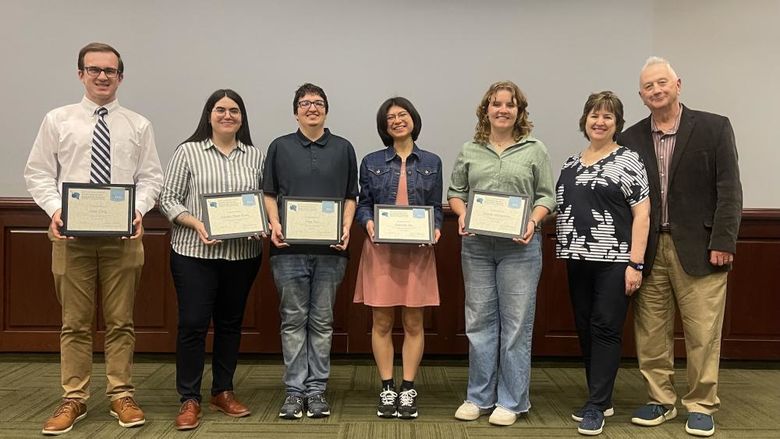
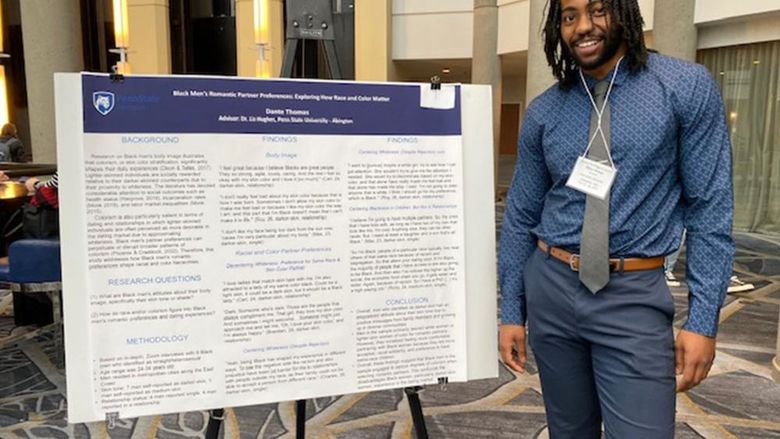
Students from three campuses contributed to grant-funded research by Faranak Courtney-Pahlevani, right, professor of mathematics at Penn State Abington, and presented their work at a regional meeting of the Society for Industrial and Applied Mathematics.
ABINGTON, Pa. — Undergraduates at Penn State campuses are developing the real-world skills employers and graduate schools demand by immersing themselves in high‑level research with faculty mentors. Recently, four computer science majors contributed to research funded by a U.S. National Science Foundation (NSF) grant awarded to Faranak Courtney-Pahlevani, professor of mathematics at Penn State Abington.
"Their participation showcased the impact of undergraduate research in inspiring creativity, teamwork and deep learning experiences, which is a testament to our students’ capabilities and dedication, and the vital research culture and leadership we continue to build together,” Pahlevani said.
The students applied mathematical and physical modeling techniques to investigate a complex biological system. According to the students, the project strengthened the technical, analytical and collaborative skills they need to become part of a STEM workforce equipped to address complex challenges.
From across the Abington, Lehigh Valley, and University Park campuses, the students worked closely with Pahlevani, building core skills while progressing toward earning their degrees. Tanisha Shah, brothers Kevin and Kyle Courtney, and Andrew Hertzberg presented their findings at a regional meeting of the Society for Industrial and Applied Mathematics, where they were recognized for their analytical rigor and interdisciplinary approach.
Shah, a fourth-year student, said Pahlevani invited her to join the team when she was enrolled in her vector calculus course at Abington.
“I contributed by applying computational thinking to mathematical problems, experimenting with models and collaborating closely with the team," she said. "Working with others allowed us to share ideas and approaches as my teammate and I had very different coding styles, and creativity played a big role in finding ways to connect theory with applications."
Kyle Courtney applied coding knowledge acquired in his coursework.
“After Tanisha and I each implemented our own versions, we came together to compare results and help each other refine our solutions. I chose an object-oriented approach and added some fun user interface features,” he said. “This project gave me more confidence that I could figure out a solution to an unknown problem.”
On a practical level, Hertzberg focused on coding visualizations to display mathematical models and their behavior and taking a deep dive into ordinary and partial differential equations. Beyond the technical work, the project offered a different kind of learning experience, he said.
“I especially appreciated the opportunity to learn more in an open-ended environment like we had in the project. It allowed for personal exploration and a much more creative journey through education,” said Hertzberg, who plans to earn a master’s in artificial intelligence.
Other Abington students advanced their academic and professional goals through Pahlevani’s NSF research. Kadence Boatman and Timmy Susai Rajan co-authored articles published in three peer-reviewed journals. The success of the student research inspired Pahlevani to broaden participation by designing a mathematics special topics course last year.
For Shah, the project strengthened her interest in artificial intelligence and applied mathematics while helping clarify her plans for graduate school. She said the experience refined her research, critical thinking, problem-solving and communication skills.
“Presenting our research was extremely valuable since explaining our work to others greatly strengthened my own understanding. Their questions and feedback helped us see new perspectives and potential improvements,” she said. “I also learned to use certain software tools and packages that proved invaluable in the following semesters.”
Shah encouraged students to talk to faculty about their interests.
“Research is a great way to learn, build confidence, form strong academic and professional connections, and discover what you truly enjoy academically,” she said.
Pahlevani said the project reflects Abington’s and the University’s commitment to personalized mentorship, interdisciplinary learning, and preparing students for graduate study and STEM careers.
Pahlevani’s project, "Mechanistic Models of Cooperative Biopolymerization," is a collaborative NSF research grant with Lisa Davis, professor of mathematics at Montana State University. Additional support was provided through the Mathematics Collaborative Research Experiences for Undergraduates.
About Penn State Abington
Penn State Abington, home to nearly 3,000 students and just minutes from Philadelphia, offers 26 four-year majors and 14 NCAA Division III athletics teams. The Abington Experience launches students from campus to career through internships, leadership development, short-term academic travel, and faculty-led research. Penn State Abington — where the city’s energy meets the best of the suburbs.